
CPU Research in Focus | From Knowledge to Habit
𝐂𝐏𝐔 𝐑𝐞𝐬𝐞𝐚𝐫𝐜𝐡 𝐢𝐧 𝐅𝐨𝐜𝐮𝐬 | From Knowledge to Habit
Bins alone do not teach. Modeling the behavior does.
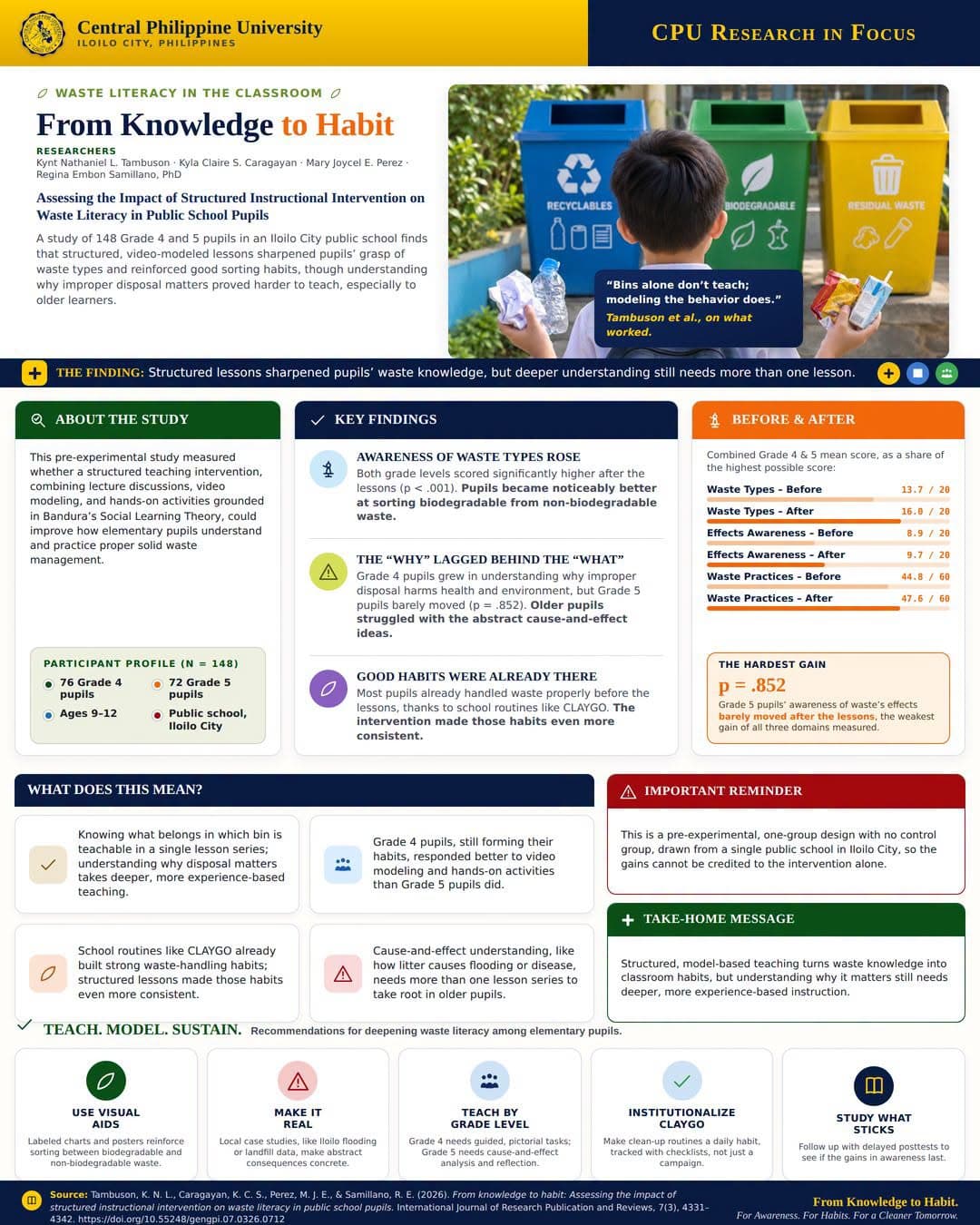
A study of 148 Grade 4 and 5 pupils in an Iloilo City public school finds that structured, video-modeled lessons sharpened pupils' grasp of waste types and reinforced good sorting habits. But understanding why improper disposal matters proved harder to teach, especially to older learners.
What the study found:
Awareness of waste types rose significantly after the lessons. Pupils became noticeably better at sorting biodegradable from non-biodegradable waste.
The "why" lagged behind the "what." Grade 4 pupils grew in understanding why improper disposal harms health and the environment, but Grade 5 pupils barely moved. Older pupils struggled with the abstract cause-and-effect ideas.
Good habits were already there. Most pupils already handled waste properly before the lessons, thanks to school routines like CLAYGO. The intervention made those habits even more consistent.
The hardest gain? Grade 5 pupils' awareness of waste's effects barely moved after the lessons; it was the weakest gain of all three domains measured.
The takeaway is clear: structured, model-based teaching turns waste knowledge into classroom habits, but understanding why it matters still needs deeper, more experience-based instruction.
Read the full study to see the recommendations for deepening waste literacy among elementary pupils.
#CentralPhilippineUniversity #CPUResearchInFocus #WasteLiteracy #SolidWasteManagement #CLAYGO #EnvironmentalEducation #ScientiaEtFides #FromKnowledgeToHabit