
CPU Research in Focus | Struggle Toward Peace
"If it is possible, as far as it depends on you, live at peace with everyone." Romans 12:18, NIV
As Christians, we are called to be peacemakers. But how do we build peace with our Muslim neighbors in Mindanao? This study offers a path forward by listening deeply to Islamic liberation theology and discovering shared ground for collaborative peacebuilding.
What this study reveals:
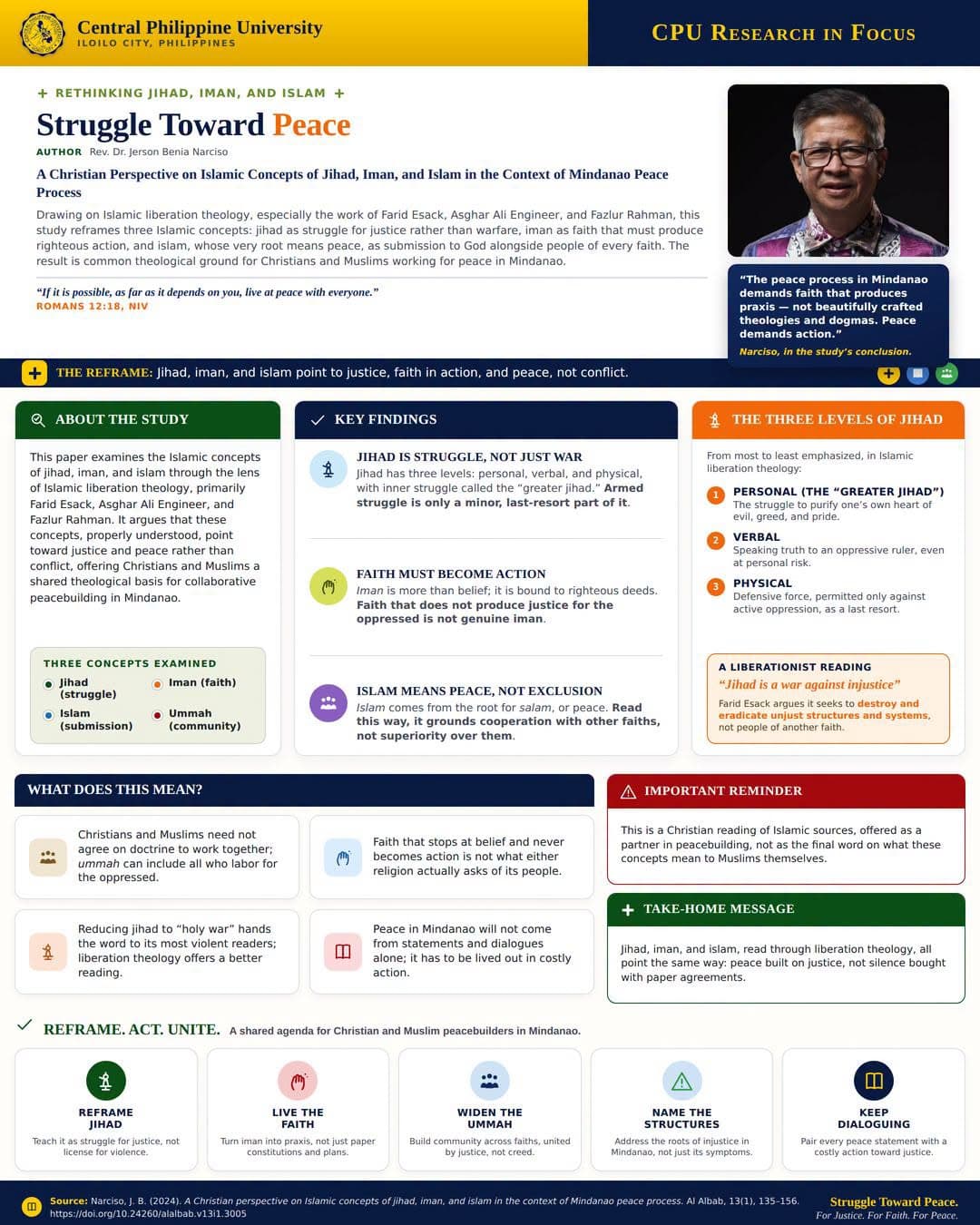
Jihad is struggle, not just war. It has three levels: personal, verbal, and physical, with inner struggle called the "greater jihad." Armed struggle is only a minor, last-resort part of it. As Christians, we can recognize this as a call to examine our own hearts first before pointing fingers at others.
Faith must become action. Iman is more than belief; it is bound to righteous deeds. Faith that does not produce justice for the oppressed is not genuine faith. This echoes our own scripture: "Faith without works is dead" (James 2:26).
Islam means peace, not exclusion. Islam comes from the root for salam, or peace. Read this way, it grounds cooperation with other faiths, not superiority over them. This invites us to see our Muslim neighbors not as strangers or rivals, but as fellow travelers seeking God's peace.
The three levels of jihad, from most to least emphasized, are personal (the struggle to purify one's own heart), verbal (speaking truth to an oppressive ruler, even at personal risk), and physical (defensive force, permitted only against active oppression, as a last resort).
The takeaway is clear: Christians and Muslims need not agree on doctrine to work together. The ummah, the community of faith, can include all who labor for the oppressed. Peace in Mindanao will not come from statements and dialogues alone. It has to be lived out in costly action.
Read the full study to see the shared agenda for Christian and Muslim peacebuilders in Mindanao.
#CentralPhilippineUniversity #CPUResearchInFocus #StruggleTowardPeace #MindanaoPeace #InterfaithDialogue #ScientiaEtFides